

Alite
•
January 19, 2026
•
4 minutes


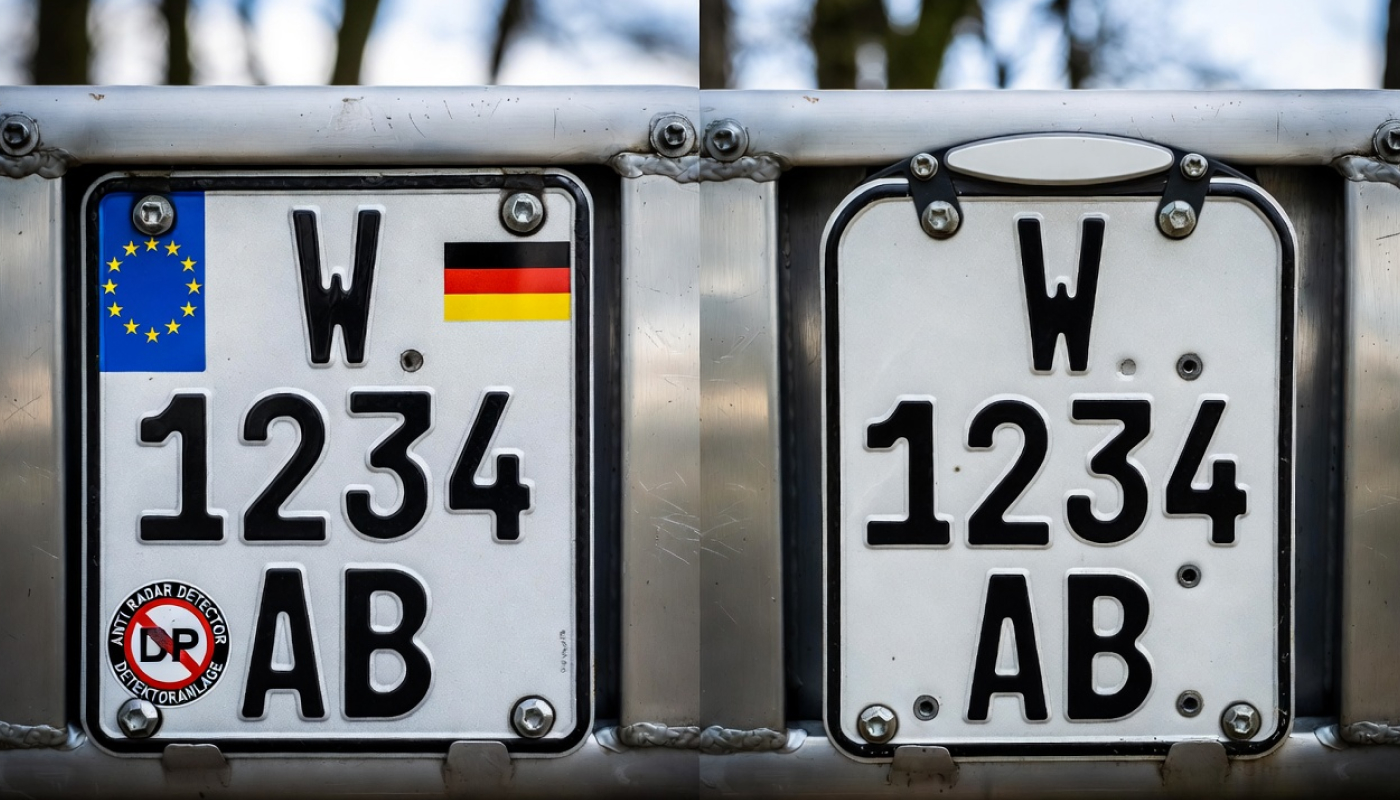
Cities today rely less on human supervision and more on machine intelligence. High-speed cameras and neural networks monitor every vehicle crossing a junction. This algorithmic precision, however, has given rise to counter-innovation - antiradar stickers that challenge the clarity of artificial vision.
What began as experimental accessories have evolved into engineered optical tools designed to confuse detection systems. The idea is simple: if cameras can think, then drivers can innovate too - not to hide, but to regain control of how they are seen.
Every anti radar sticker operates on the physics of reflection. Cameras don’t “see” letters the way humans do; they analyze light contrast and geometry. These stickers manipulate that light before it reaches the lens.
By embedding microscopic reflective layers, they scatter or absorb specific wavelengths, making the plate appear distorted to recognition algorithms. The plate looks normal to human eyes but becomes unreadable under infrared or high-intensity flashes - creating a digital illusion in plain sight.
This conflict between detection and disruption defines modern optical engineering - precision built not to deceive, but to question how far automation should see.
Unlike bulky covers or mechanical blockers, a anti radar license plate sticker works on principles of optical interference. When light strikes its nano-coated surface, part of the beam is reflected in multiple directions.
These reflections confuse ALPR systems, which rely on consistent luminance patterns. Even a few milliseconds of disrupted feedback can cause recognition algorithms to fail. The technology doesn’t make a car invisible - it simply alters the rhythm of light long enough to blur digital certainty.
In essence, physics becomes privacy - light becomes resistance.
Among new-age materials, Alite Nanofilm exemplifies precision and refinement. It doesn’t rely on metallic particles but uses nanostructured layers to control how light interacts with the plate surface.
This makes it a standout anti camera sticker solution. The coating provides even reflection during the day while minimizing infrared glare at night. It integrates seamlessly with any design, keeping the plate’s aesthetic intact while subtly confusing optical scanners.
Its advanced nanostructure maintains consistent optical performance regardless of weather or angle. Alite Nanofilm demonstrates that privacy technology can be elegant - a perfect equilibrium of discretion and design.

The term invisible number plate often sparks curiosity - not because it’s truly invisible, but because it represents control over digital visibility. In a world where everything is traceable, optical privacy has become an act of self-definition.
Drivers no longer view privacy as secrecy but as balance. Technologies like antiradar stickers or nanofilms allow people to decide how they are perceived by automated systems. This shift is part of a larger cultural trend: treating data exposure as a matter of choice, not inevitability.
Each reason highlights that privacy today is not physical concealment - it’s optical autonomy.
Machine learning algorithms continue to evolve. They adapt to weather, lighting, and even partial obstructions. Yet the nuanced physics behind antiradar stickers keeps challenging AI precision. Cameras rely on predictable light; when that light behaves unpredictably, data breaks down.
This invisible tug-of-war has no winner - only evolution. As detection becomes smarter, counter-materials like anti radar sticker films grow more sophisticated. The result is a dynamic balance between surveillance and innovation, visibility and discretion.
The story of antiradar stickers is not about resistance but refinement - a rethinking of how humans coexist with algorithms. Products like Alite Nanofilm embody this philosophy, merging nanotechnology with optical intelligence.
In the age of constant observation, light has become both a signal and a shield. Through innovations like the anti radar license plate sticker and anti camera sticker, the invisible battle continues - not in darkness, but in brilliance.
Car
Nanofilm
Vehicle
Written by Alite
Read more
We cover privacy tech, license plate protection & smart ways to stay off surveillance. No gimmicks — just real tools that work. Explore more:
MORE FROM ALITE
Made by drivers, for drivers







Comments
Jonathan Reed
21 January 2026
The AI vs optics angle was actually really cool.
Emily Carter
01 February 2026
Smart, modern, and a bit philosophical.
03 February 2026
Makes you think about privacy in a new way