
Alite
•
February 14, 2026
•
4 minutes


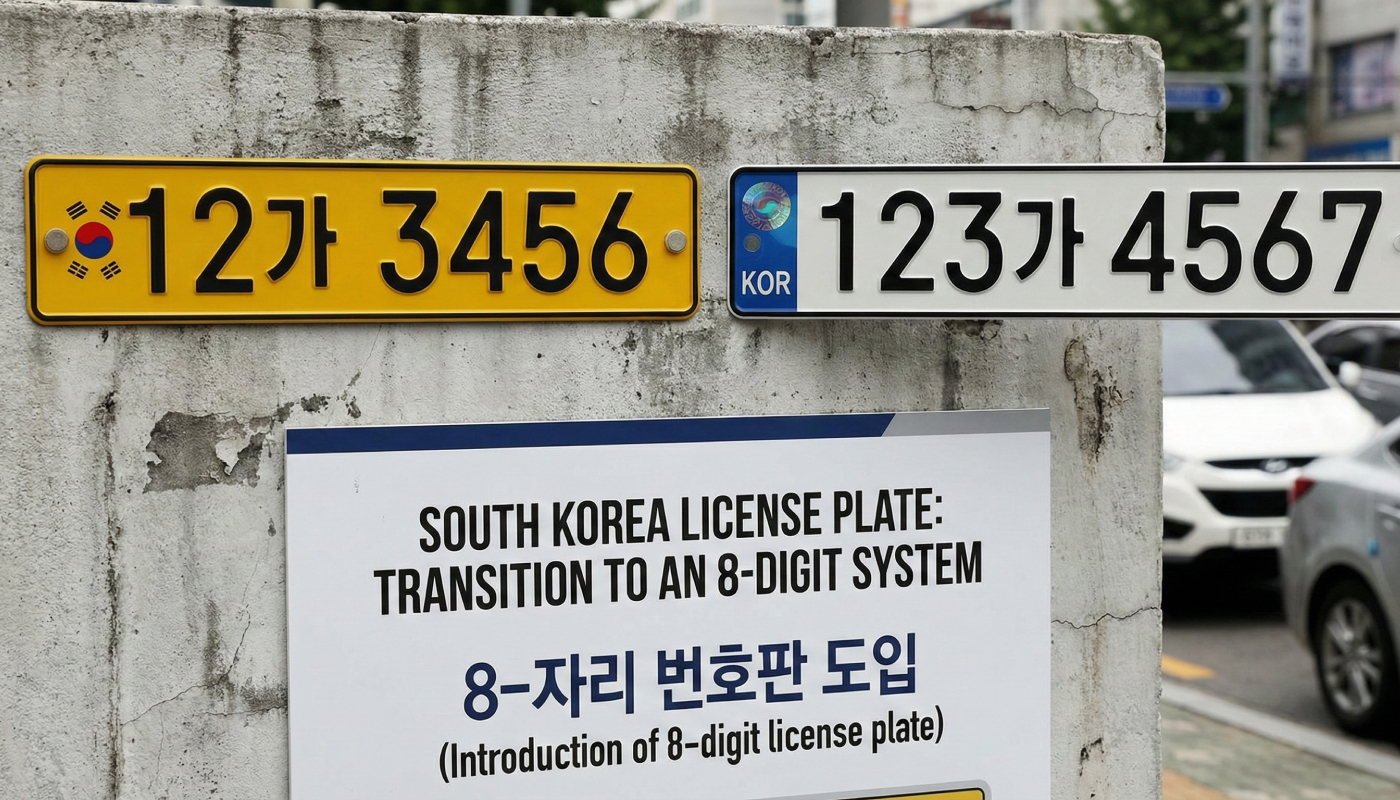
South Korea’s transition to an 8-digit license plate system marked one of the most significant structural updates in modern vehicle identification. The change was driven by the rapid increase in vehicle registrations, yet it brought unintended consequences in the field of optics and machine vision. With expanded character sets, bolder typography, stronger reflectivity, and new manufacturing standards, the visual behavior of Korean plates has become more complex especially under different lighting environments.
In parallel, various optical materials such as reflective number plate film, light-scattering coatings, and engineered surface treatments have introduced a new dimension to how cameras interpret these plates. The shift to eight digits is not just a numerical adjustment - it is an optical transformation.
The new Korean plates feature denser layouts, extended character spacing, and a modified reflective layer intended to enhance nighttime visibility. While these improvements benefit human recognition, they also create more complex reflection patterns for automated systems.
In night conditions, the broader reflective layer intensifies how the surface interacts with car headlights and overhead illumination. For ALPR (Automatic License Plate Recognition) systems, this means more light to analyze and more opportunities for reflective irregularities. When paired with overlays or optical coatings, the plate’s surface becomes even more unpredictable, sometimes producing a subtle ghost plate effect in camera footage.
This effect is not visual to humans, but the sensor detects duplicated or blurred edges when bright reflections interfere with the segmentation process.
One surprising outcome of the new 8-digit plates is the increase in total reflective area. Larger surfaces naturally interact with light more dynamically, especially when coated with materials like light scatter film.
These films disperse incoming illumination in different micro-directions, creating an unstable reflection field. Light no longer returns to the camera in a predictable beam. Instead:
In a dense urban environment like Seoul or Busan, where LED streetlights, digital signage, and IR scanners overlap, this scattering becomes even more pronounced. Cameras interpret the plate as a moving patchwork of bright and dark zones.
Humans see the characters normally. Sensors see a constantly shifting geometry.

Some drivers compare modern coatings to a basic anti camera number plate sticker, but the technologies operate on fundamentally different principles. Stickers rely on directional glare or flash reflection, making them dependent on specific angles and outdated scanning systems.
With Korea’s 8-digit plates, these simple stickers behave inconsistently. The new reflective underlayer is already highly responsive to illumination, which makes the glare-based approach unstable. Camera angles change rapidly in heavy traffic, and infrared illumination is now more dominant than visible light.
In contrast, engineered optical coatings alter light at a structural level. They do not rely on sudden bursts or perfect alignment. Instead, they influence the waveform behavior of light redirecting, diffusing, and flattening illumination. The result is not a blinding glare but a patterned inconsistency that cameras cannot easily model.
This is why optical engineering became a key point of interest after the 8-digit rollout.
The Korean roadway ecosystem includes tunnels, elevated expressways, pedestrian-level LED signage, and tightly spaced traffic lanes. These create complex lighting conditions where a reflective number plate film behaves very differently from its textbook expectations.
At night, reflective films distribute headlight beams across a broad range of angles. The new 8-digit plates, especially with their enhanced reflectivity, amplify this dispersion. Cameras do not capture clean silhouettes; instead, they encounter:
In daylight, the problem shifts. The reflective surface interacts with strong shadows cast by overhead structures, creating alternating bright and dark bands across the plate. With engineered optical coatings on top, this creates a compounded effect - one that sensors struggle to resolve into a stable reading.
A true invisible license plate is a myth - the human eye continues to see the characters. What does occur, however, is the optical invisibility in the sense of machine uncertainty. The new Korean plates, when combined with scattering or reflective treatments, occasionally produce frames where the camera cannot reconstruct the characters reliably.
This is not disappearance. It is data instability - the sensor sees noise where shape should be.
Urban density intensifies this phenomenon. South Korea’s light pollution levels are among the highest in Asia, meaning reflective and scatter-based coatings interact with dozens of overlapping wavelengths. Each additional light source increases the probability of optical misinterpretation.
South Korea’s transition to an 8-digit license plate system was meant to address administrative needs, but it also opened a new chapter in optical behavior on the road. With more reflective surface area, denser layouts, and advanced visibility coatings, the plates now interact with modern light sources in ways that researchers did not fully anticipate.
In an environment filled with LEDs, IR scanners, and directional beams, the updated design has turned into an optical case study where brightness, scattering, and structural reflectivity merge into a new kind of complexity.
The 8-digit system is not only a bureaucratic update. It is a transformation in how light, technology, and surface design collide.
Car
Nanofilm
Vehicle
Written by Alite
Read more
We cover privacy tech, license plate protection & smart ways to stay off surveillance. No gimmicks — just real tools that work. Explore more:
MORE FROM ALITE
Made by drivers, for drivers












Comments
Daniel Kim
21 February 2026
The urban lighting analysis is incredibly detailed.
Sofia Martinez
15 February 2026
Great explanation of how the 8-digit format changed optics
Andrew Park
19 February 2026
Feels like a technical case study, very insightful.